

Level 9 Starts at Level 1: Why Most Sites Are Looking at Intervention Before Optimising the Foundations
Why most sites are looking at intervention before optimising the foundations
As collision avoidance technologies continue to evolve, conversations across the mining industry are increasingly focused on intervention systems, autonomous operations and the future of machine safety.
Terms such as Level 9 Collision Avoidance, Machine Interface Controllers and autonomous intervention are now common in vendor presentations, safety discussions and project planning. That discussion is important, but it can also create a false starting point.
The answer begins with understanding what the EMESRT / Vehicle Interaction framework actually represents.
Understanding the EMESRT / Vehicle Interaction Framework
One of the most common misconceptions in the collision avoidance market is that EMESRT Levels 1 to 9 represent a technology ladder. They do not.
The EMESRT Vehicle Interaction framework is better understood as a hierarchy of controls designed to reduce the risk of interactions between people, vehicles and mobile equipment. Technology is only one part of the hierarchy. The lower layers are about how an operation is designed, managed, supervised and controlled before technology is applied.
In practical language, the hierarchy moves from operational and administrative controls through to the technology layers:
- Level 1 – Site and operational design
- Level 6 – Operating compliance and supervision
- Level 2 – Segregation and exclusion zones
- Level 7 – Operator Awareness
- Level 3 – Traffic management procedures
- Level 8 – Advisory Controls
- Level 4 – Authority to operate
- Level 9 – Intervention Controls
- Level 5 – Operator competency and fitness for work
This distinction matters because it changes the way organisations should think about collision avoidance. Level 9 is not the beginning of the journey. It is the final layer added to an already mature system of controls.
Why visibility still matters
In an industry increasingly focused on sensors, artificial intelligence, machine interfaces and intervention technology, one of the most effective safety controls remains surprisingly simple: visibility.
Poor visibility contributes to delayed hazard recognition, reduced situational awareness and slower response times. Whether the risk exists at a loading area, refuelling bay, workshop, haul-road intersection, ROM pad or pedestrian access point, visibility directly influences a person’s ability to identify and respond to developing hazards.
Well-designed lighting and visibility controls improve:
- hazard identification
- pedestrian visibility
- operator awareness
- maintenance quality
- CCTV and camera-system effectiveness
- the time available to respond to developing risks
Before introducing more sophisticated technology, sites should ask a simple question: are we giving people the best possible opportunity to see and understand what is happening around them?
Level 7: Awareness
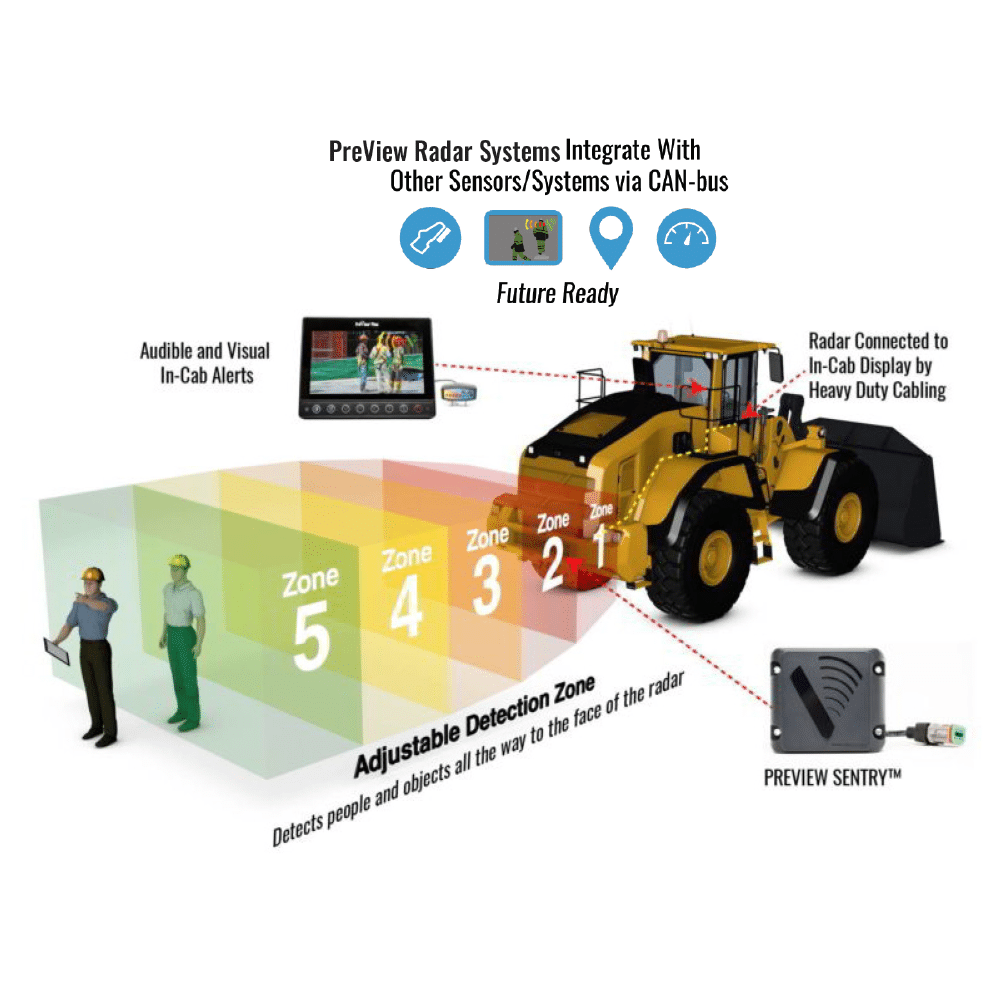
Level 7 is where technology begins to support the hierarchy through operator awareness. Technologies such as radar systems, camera systems, AI-assisted vision and proximity detection help operators understand what is occurring around their equipment.
For many sites, this is the most practical starting point. The objective is to detect hazards and improve situational awareness. The stronger the awareness layer, the stronger the foundation for every subsequent control.
Level 8: Advisory Controls
Level 8 takes the next step by actively advising the operator of risk through warnings, alarms and risk-prioritised alerts. Rather than simply presenting information, advisory systems begin interpreting events and drawing attention to developing hazards.
One of the most important developments in recent years has been the use of AI-enabled camera systems. Traditional camera systems improve awareness. AI-enabled systems can also classify hazards and reduce nuisance alarms by identifying what actually matters. This is strategically important because operators are far more likely to trust and retain systems that warn when it matters, rather than systems that alarm continuously.
The objective remains practical: help operators make better decisions more consistently.
Level 9: Intervention
Level 9 is where intervention occurs. At this point, a system may automatically reduce speed or stop equipment when collision conditions are met and the operator does not respond appropriately.
Level 9 understandably attracts attention because it represents a significant step forward. However, intervention cannot be viewed in isolation.
There is no effective intervention without reliable detection. There is no effective intervention without advisory logic. There is no effective intervention without the operational controls that sit beneath the technology layers.
In many respects, Level 9 is not a replacement for the lower layers. It is a final layer built on top of them.
What being Level 9 ready really means
Being Level 9-ready should not be treated as a claim about one product. It should be treated as a capability pathway.
A site moving towards intervention should consider:
- Have visibility risks been identified and addressed?
- Are future integrations being considered today?
- Are awareness systems fitted, calibrated and maintained effectively?
- Is the site building a practical upgrade path rather than buying isolated devices?
- Are advisory controls understood and trusted by operators?
- Is traffic management mature enough to support intervention technology?
These questions are often more valuable than simply asking which Level 9 system should be installed. The best collision avoidance outcomes are typically built on strong foundations, not used to compensate for weak ones.
A better industry conversation
The mining industry is right to be interested in intervention technology. Machine-to-machine communication will continue to improve. Automation will continue to evolve. Standards and customer expectations will continue to rise.
But the lesson embedded in the EMESRT Vehicle Interaction framework is clear: safety does not start at Level 9. It starts at Level 1.
The future of collision avoidance is therefore not just about intervention. It is about creating operating environments where visibility, awareness, advisory controls and intervention systems work together to improve situational awareness across the entire operation.
At APS, we believe the strongest safety outcomes come from building the foundation first, then creating a practical pathway towards becoming genuinely Level 9-ready.
Contact your local APS representative to discuss how we can tailor a solution to meet your needs.
 English
  Spanish