

From Awareness to Action: Building Practical Level 9-Ready Pathways for WA Mining Operations
Building practical Level 9-ready pathways for WA mining operations
In the first part of this series, APS explored a simple but important idea: Level 9 starts at Level 1.
The point was not to reduce the importance of intervention technology. The point was to place it in the right context. Within the EMESRT Vehicle Interaction hierarchy, Level 9 intervention sits above a broader set of controls, including site design, segregation, operating procedures, operator capability, compliance, awareness and advisory controls.
For Western Australian mining operations, the practical question is now different:
WA mining needs practical pathways, not isolated products
Western Australia’s mining sector operates across diverse conditions: large open-cut operations, remote haul roads, mixed fleets, contractors, light vehicles, workshops, ports, processing areas and high-traffic maintenance environments.
In these environments, collision avoidance is rarely solved by one product. It requires a systems approach that considers how people, machines, vehicles and infrastructure interact every day.
That is why the most effective safety strategies are often staged. They allow an operation to strengthen today’s controls while keeping a credible pathway open for future intervention capability.
Step 1: Map the interaction risk
Before selecting technology, sites should identify where the highest-risk interactions actually occur. These may include haul-road intersections, workshop approaches, refuelling areas, loading zones, stockpile areas, ROM pads, dump points, pedestrian crossings, contractor access points and light-vehicle operating areas.
A practical review should ask:
- Where do people and machines interact most often?
- Where are current warning systems inconsistent or difficult to interpret?
- Which machines or areas would benefit most from detection, advisory or intervention capability?
- Where is visibility compromised?
- Where do operators experience alarm fatigue?
This type of assessment helps prevent technology from being deployed as a generic layer, and instead directs investment towards the risks that matter most.
Step 2: Strengthen the visibility and awareness layer
Visibility remains a foundation control. Good lighting, well-positioned warning devices and fit-for-purpose camera or radar systems improve the ability of people to understand what is happening around them.
For many operations, the first commercial and safety opportunity is not full intervention. It is a stronger Level 7 awareness layer supported by reliable sensing, operator visibility and site-specific installation.
This is also where quality of installation and calibration matters. A system that is poorly located, poorly maintained or poorly understood may create nuisance alarms or low operator trust. A system designed around the machine, application and site conditions is far more likely to stay in use and deliver value.
Step 3: Move from awareness to advisory controls
The next step is moving from awareness to advisory controls. This is where systems begin to interpret risk and help operators prioritise their response.
AI-enabled camera systems, radar technologies and other sensing platforms can play complementary roles. Cameras can provide visual context and classification. Radar can support distance, speed and detection performance in challenging conditions. Together, they can support better warning logic and reduce nuisance alarms.
This is important because advisory systems only deliver value when operators trust them. A warning system that constantly alarms at low-value objects risks being ignored or disabled. A system that warns when it matters is more likely to influence behaviour.
Step 4: Remain Level 9-ready without overclaiming
For many sites, Level 9 intervention will become increasingly relevant as customer expectations, standards, automation and regulation evolve. However, being Level 9-ready does not mean every site needs to move immediately to machine intervention across every asset.
A practical Level 9-ready pathway means building today’s detection and advisory systems in a way that keeps future upgrade options open.
It also means recognising that intervention generally requires a machine interface and control layer that must be handled carefully through appropriate partners, standards and machine-specific integration.
For APS, the position is deliberate: support clients with the sensing, visibility, installation, advisory and integration foundations, while working with proven control partners where intervention capability is required.
Step 5: Treat implementation as an operating discipline
Collision avoidance should not be treated as a one-off purchase. It is an operating discipline.
Successful programs typically require:
- application review and system selection
- installation designed around the machine and site
- operator training and clear communication
- calibration and commissioning
- maintenance and support
- review of nuisance alarms and operator acceptance
- a staged upgrade path for future intervention requirements
This is where local presence matters. A supplier that can support customers before, during and after deployment is better placed to help sites move from product installation to safety outcome.
The APS view
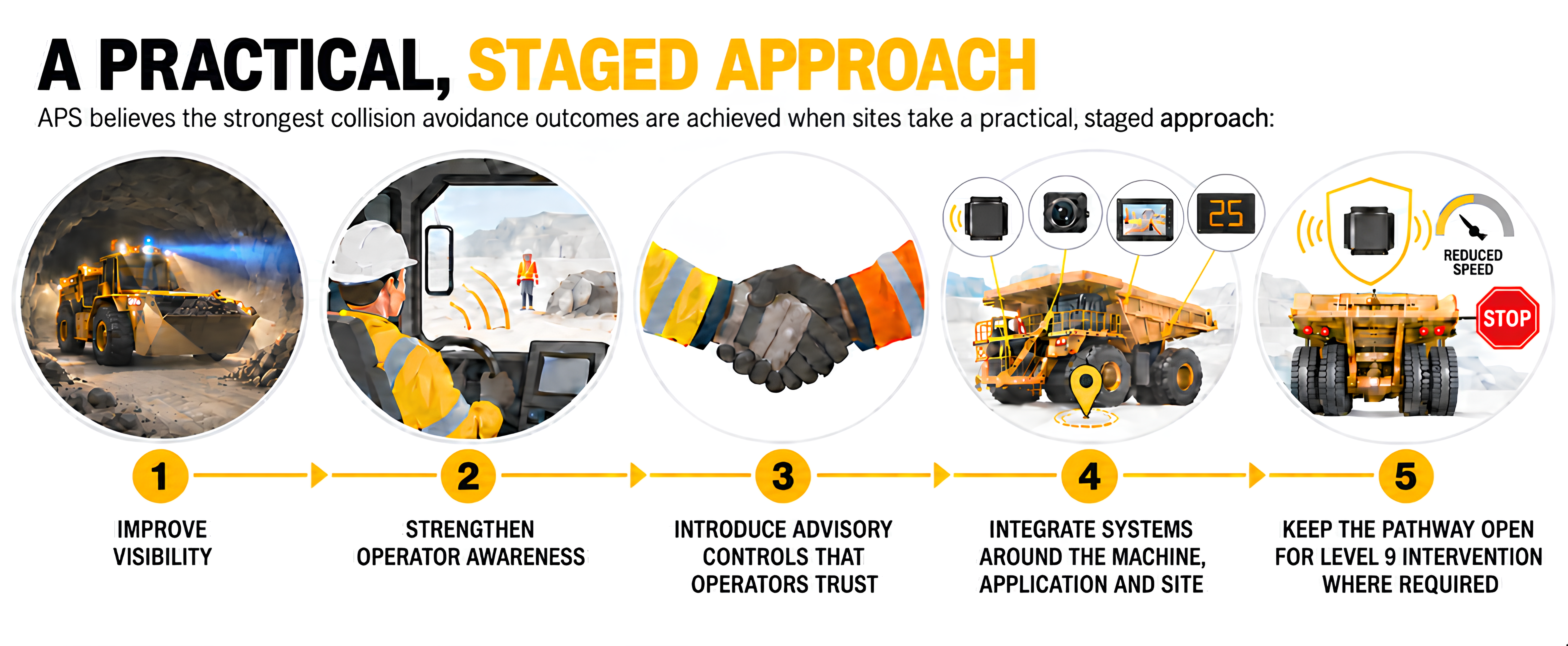
This approach recognises the reality of mixed fleets, operating budgets, site constraints and different levels of readiness across the industry.
The future of mining safety will continue to include more connected and automated systems. But the sites best placed to benefit from that future will be those building the foundations today.
For WA mining operations, the opportunity is not simply to ask how quickly a site can reach Level 9. It is to ask whether the site is building a practical, supportable and scalable pathway from awareness to action.
Contact your local APS representative to discuss how we can tailor a solution to meet your specific operational requirements.
 English
  Spanish